Mailchimp and Constant Contact charge you for your list —
not your messages
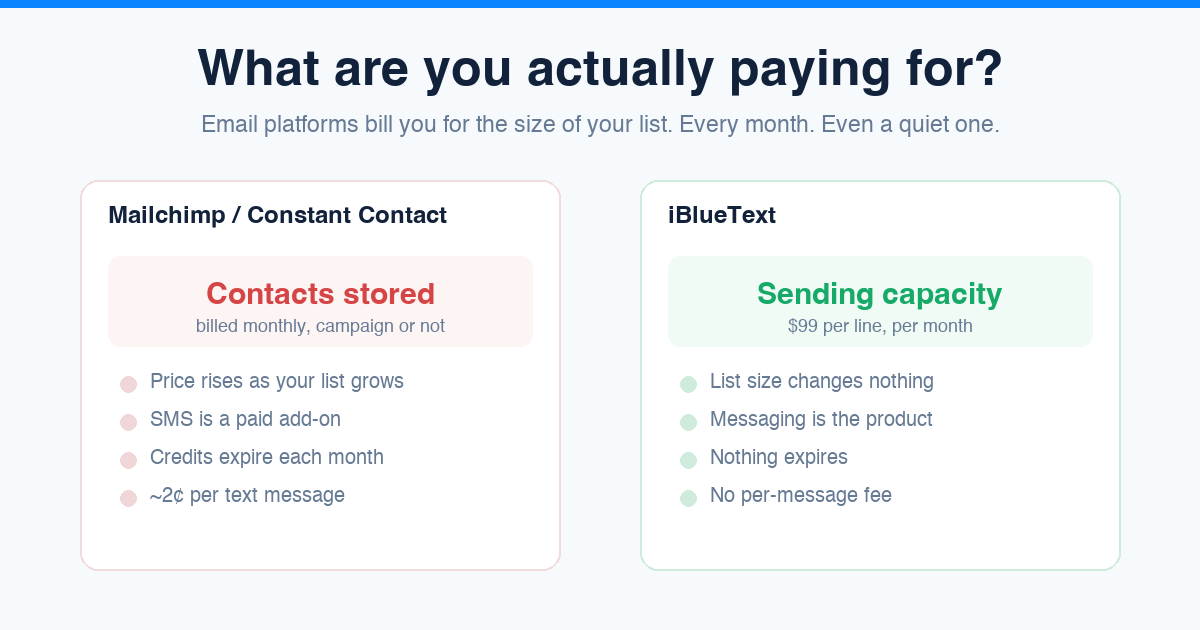
Here is the thing that catches people out about email marketing platforms: you are billed for how many people are on your list, not for how many you actually contact. A month where you send nothing costs exactly the same as a month where you run four campaigns.
That is a perfectly normal way to price email software, and for a long time nobody minded much. It gets stranger when the same platforms start selling you text messaging on top of it.
What each one charges
Mailchimp
Priced by contact count, across Essentials, Standard and Premium:
- 500 contacts — Essentials $13/mo, Standard $20/mo
- 5,000 contacts — Essentials $75/mo, Standard $100/mo
- 10,000 contacts — Premium from $350/mo
- 25,000 contacts — Premium $620/mo
SMS is a separate add-on, from $20/month for around 1,000 messages, and it is subject to approval. It is not available on the free plan. Mailchimp does not publish a clean per-message rate, but the arithmetic lands near 2¢ a message.
Constant Contact
Also priced by contact count:
- 500 contacts — Lite $12/mo, Standard $35/mo, Premium $80/mo
- 1,000 contacts — Lite jumps to $30/mo
- 5,000 contacts — Standard $110/mo, Premium $200/mo
- 25,000 contacts — up to around $425/mo
SMS starts at $10/month for up to 500 messages as an add-on on Lite and Standard; Premium includes the first 500. Again, roughly 2¢ a message. SMS is US-only.
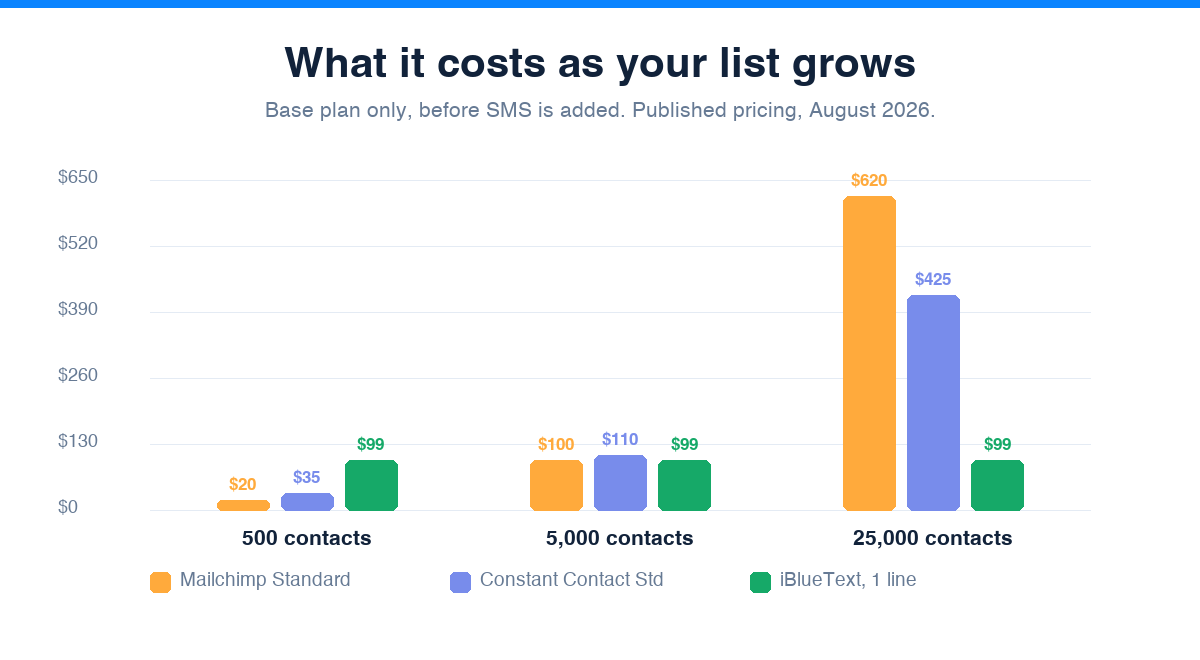
Look at the left-hand group first. At 500 contacts they cost $20 and $35 and we cost $99. If you have a small list and you want email, they are cheaper and we would be daft to pretend otherwise.
The interesting part is what happens as the list grows. Their line goes up because your list got bigger. Ours does not, because we do not charge for contacts at all — we charge for a sending line.
Three things worth knowing before you add SMS
1. The credits expire
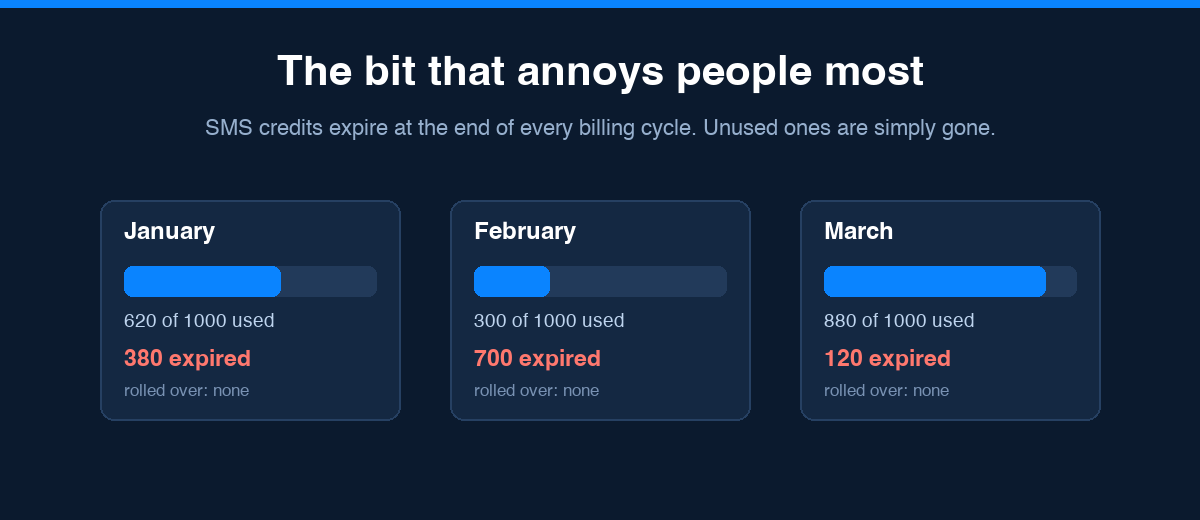
Mailchimp's SMS credits reset at the end of each billing cycle. Whatever you did not use is gone. Buy 1,000, send 400, and you paid for 600 messages that no longer exist.
If your sending is seasonal — and most businesses are seasonal — you are either over-buying every quiet month or running out in the busy ones.
2. You are billed for people who left
Mailchimp counts unsubscribed contacts and duplicates across audiences toward your total. Most accounts therefore pay for a larger list than the one they can actually email.
3. It is green-bubble SMS
This is the one that actually costs you money, and it does not appear on any invoice.
An SMS from a marketing platform arrives as a green bubble from a number nobody recognises, increasingly filtered before anyone reads it. That is exactly the problem iMessage solves — a blue bubble lands in the same thread as messages from friends, and it is not treated as bulk mail.
The part the price-per-message hides
Everything above compares broadcasts. But the moment someone replies, the two models stop resembling each other at all.
Here is a real campaign of ours — the charter-boat outreach we run for Beer Can Island — over 48 days:
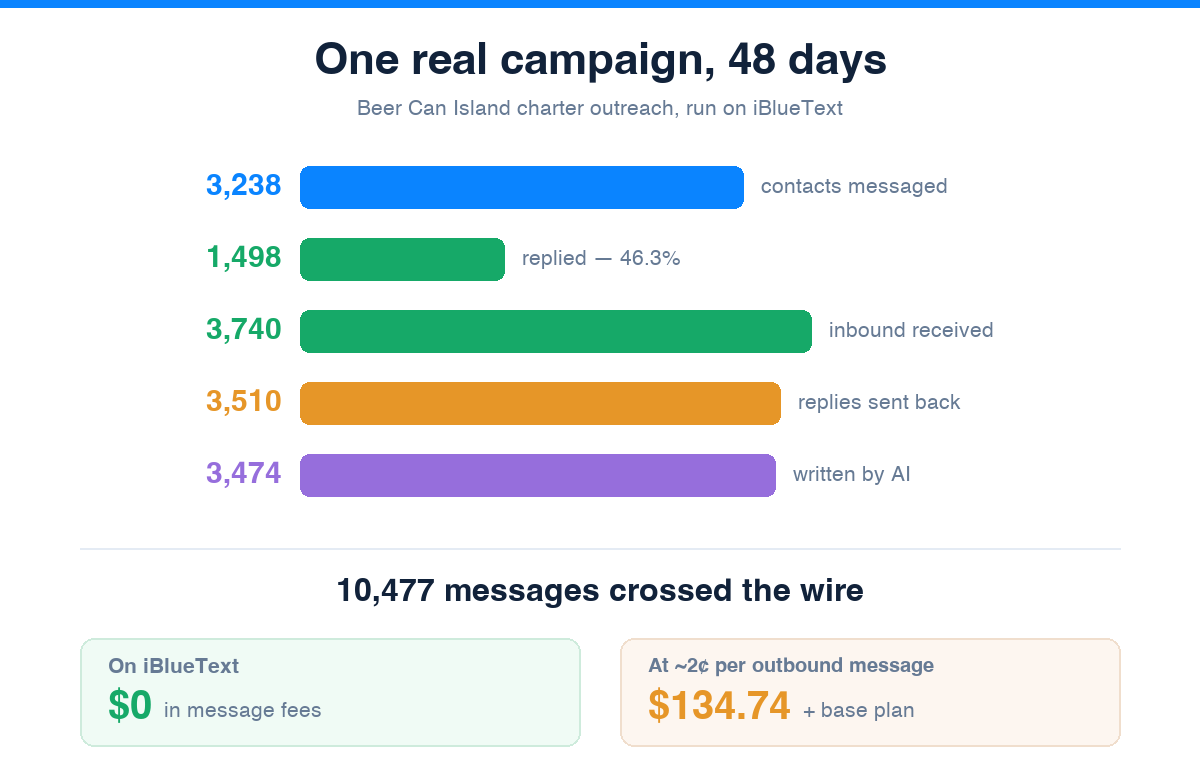
3,238 contacts. 1,498 of them replied — 46.3%. Those conversations produced 3,740 inbound messages, and we sent 3,510 replies back. Add it up and 10,477 messages crossed the wire.
Note what that does to the ratio: more than half of everything we sent was conversation, not broadcast. 3,227 campaign sends, 3,510 replies. The reply traffic was bigger than the campaign itself.
What that costs on each platform
On both Mailchimp and Constant Contact, receiving is free — but every reply you send is another credit. Mailchimp's two-way runs through EZ Texting and lands in a shared Inbox; inbound texts don't draw down credits, outbound responses do.
So that same campaign, on a credit model at roughly 2¢ an outbound message:
- 3,227 campaign sends — $64.54
- 3,510 conversational replies — $70.20
- 3,740 inbound — free
- $134.74 in message fees, on top of a base plan that would be around $100/month at that contact count
On iBlueText the same 10,477 messages cost nothing. You pay for the line. The conversation on top of it is unmetered.
That is the bit that does not show up in a pricing-page comparison: a credit model quietly penalises the thing you actually want. A campaign that gets no replies is cheap. A campaign that starts 1,500 conversations costs you more, every time someone writes back.
And somebody has to write those replies
Of our 3,510 replies, 3,474 were written by AI — answering questions about availability and pricing, at any hour, without anyone watching the inbox.
Neither Mailchimp nor Constant Contact publishes an AI agent that answers inbound texts for you. Mailchimp's Inbox is exactly that — an inbox. You, or a teammate, type the replies. That is not a criticism of the tool; it is just a different job. But at 3,500 replies it is a real cost that never appears on the invoice.
One account, as many lines as you need
We cap new contacts at 50 iMessage plus 50 SMS per line per day. That is deliberate — it is what keeps an Apple account from being flagged as a bulk sender, and it is why the messages land as blue bubbles instead of getting filtered.
What it is not is an account ceiling. Add a second line and the capacity doubles; the campaign above ran across four lines on one account. And the cap only ever applies to first contact — once somebody replies, that conversation is unlimited, forever, at no extra cost.
Where we are cheaper, and where we are not
Being straight about this is more useful than a table where we win every row.
| iBlueText | Mailchimp | Constant Contact | |
|---|---|---|---|
| Billed by contact count | No | Yes | Yes |
| Cost to send a message | $0 | ~2¢ | ~2¢ |
| Cost to reply in a conversation | $0 | ~2¢ each | ~2¢ each |
| Unused allowance expires | Nothing to expire | Yes, monthly | Yes |
| AI answers inbound texts | Yes, add-on | No | No |
| Add more capacity | Add a line | Buy more credits | Buy more credits |
| Cost at 500 contacts | $99 | $20 | $35 |
| Cost at 25,000 contacts | $99 / line | $620 | ~$425 |
| Sends real iMessage | Yes | No | No |
| Email marketing | No | Yes | Yes |
| New contacts per day | 100 / line, scales with lines | Credit-limited | Credit-limited |
Two rows there go against us and both matter.
We do not do email. If you need newsletters, templates and list management, you need one of them — quite possibly alongside us rather than instead of us.
And if your list is small, they are cheaper. At 500 contacts, $20 beats $99 and no amount of arguing changes that.
So who is this actually for?
If your list is small and you mostly send newsletters, stay where you are.
Consider us when the numbers stop making sense:
- Your contact bill keeps climbing while your sending stays flat.
- You are buying SMS credits and watching some expire every month.
- Your texts are not getting read, and you suspect filtering rather than disinterest.
- People actually reply to you, and each of those replies is costing you a credit.
- Nobody has time to sit in an inbox answering the same questions at 9pm.
Our pricing, in one paragraph
$99 per line per month, plus a $249 one-time setup per line. $0.005 per iPhone lookup, flat. No per-message fees, no contact-count pricing, no credits, nothing that expires, no contract. All of it is on the pricing page — you do not have to book a call to see it.
Check your own list first
Run 100 numbers free and see how many are actually on iMessage before you spend anything. No card, no demo.
Start free See pricingMailchimp and Constant Contact pricing compiled from published plan pricing and public pricing summaries, August 2026, and believed accurate at the date of publication — both vendors price by contact tier and change their rates, so check their own pages before deciding. iBlueText is not affiliated with, endorsed by, or partnered with Intuit Mailchimp, Constant Contact or Apple. Mailchimp is a trademark of Intuit Inc. Constant Contact is a trademark of Constant Contact, Inc. iMessage and Apple are trademarks of Apple Inc.